Willie Blog


One Man’s Vision, 40 Years of Willie Boats
A Willie Boats 40th Anniversary Feature
Every so often, an older Willie Boat returns to the shop in Central Point, Oregon. It might have been built in the 1980s or 1990s, but what really catches the Willie Boat crew’s attention isn’t just the boat’s age. More often, it’s a unique feature, a clever design, or a special way it was built that makes everyone pause and take a closer look.
“We look at it and think to ourselves, ‘How on earth did someone come up with that long ago?’” Ron Bernhardt, the production and shop manager at Willie Boats and a member of the company for nearly 28 years, said. “The things he was doing in the ’80s never occurred to anybody at the time.”
Willie Illingworth founded the company, and even forty years after Willie Boats was officially incorporated in 1986, his name is still closely tied to it. As the company celebrates its 40th anniversary, seeing these boats come back to the shop feels like the perfect way to mark the milestone. The boats show that Willie built things to last, and that his approach to solving problems, working with people, and moving forward has stood the test of time too.
Building the Boat He Could Not Find
Willie started shaping the world of aluminum boats long before the company officially began. In 1971, he set out to build what many believe was the first aluminum McKenzie River drift boat, when drift boats were still made of wood. Willie wanted something different: a boat that could handle whitewater, was easy to row, and could last for years of hard use.
At first, Willie tried to get existing manufacturers to build the boat he wanted, but when they turned him down, he decided to do it himself. He faced real challenges; he didn’t know how to weld, and he had lost his left hand in an accident. Still, none of that changed his determination to solve the problem or his belief that he could.
That first try set the tone for Willie’s whole career. He didn’t innovate just to be different. Instead, he started by thinking about what a boat really needed to do on the water, questioned the usual ways of building, and then figured out a better solution. As a result, the aluminum drift boat went from a strange idea to the industry standard.
A Company Shaped on the Shop Floor
People often tell the story of Willie Boats by talking about hull designs and new models. But companies rarely last 40 years on products alone. They survive because knowledge is shared from person to person, and because people have reasons to stay and keep that tradition going.
Bernhardt is a good example. He’s about to turn 51 and has spent more than half his life at Willie Boats. He remembers Willie as demanding but fair, and as someone who recognized real commitment.
Bernhardt said, “If he liked you and you did a good job for him, then he treated you very well and respected you,” and added that he had learned a great deal from Willie; it had been a nice journey.
High expectations and respect for each person helped create a culture where people learned craftsmanship through hands-on experience, not just by following instructions. Willie’s standards showed up in everyday work: how the hull was laid out, how a weld was finished, how the boat performed, and in the builder’s willingness to rethink familiar solutions. Long-service employees didn’t just build boats; they understood the reasons behind the designs. When the company expanded beyond drift boats, the accumulated knowledge enabled Willie Boats to grow without abandoning the practical, performance-oriented approach that had originally established it.
Always Pushing the Design Forward
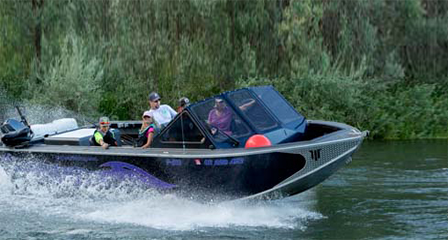
In 1987, customers started asking Willie for a more powerful powerboat. The company responded by introducing flat-bottom models, then developed new designs that expanded what a Willie Boat could do. That year, they launched the Predator, which became one of their long-lasting models. Later boats took on new waters and uses, but the development process stayed the same: listen to what people need, see how the boat performs, and keep improving it.
Bernhardt said he always tried to go further than anyone else in his work, and that this is still true for the company today. His legacy is that the aim had never been to keep his designs as museum exhibits but to preserve his instinct for improving them; if we are to respect the founder, we must carry on the work, not stop it.
Willie died in 2007, but before his death, ownership passed to Bittle, a long-time employee who knew both the company and the expectations connected with its name. This change showed what Willie had been developing alongside the boats: a company capable of meeting its standards even after the founder was gone.
What 40 Years Really Measures
You can count an anniversary in years, but in boatbuilding, real longevity shows in the number of boats still on the water, the customers who keep coming back, and the employees who have spent decades on the job. Their ideas are still valuable long after they were first sketched or welded into aluminum.
For Willie Boats, 40 years represents thousands of decisions made to keep up the standard set by a man who rarely took the easy way out. This legacy belongs to the boat builders who shared his lessons, the owners who trusted the name, and the fishing and boating communities who tested every design where it matters most: on the water.
Bernhardt has a simple explanation for why the company has lasted: they always aim to make the best product they can, year after year.
“Reaching the top is the simple part,” he said, “since anyone can get there; the difficult part is staying on top, and this requires a great deal of work and dedication.”
Today, Willie Boats is part of North River Boats, bringing together two Pacific Northwest aluminum boat brands with a shared commitment to craftsmanship, performance, and long-term durability. The relationship gives Willie Boats added strength and resources for the years ahead while preserving the identity Willie created. The boats still carry his name, and the company still measures itself against the standard he set.
That work is the real thread connecting Willie’s first aluminum drift boat to the Willie Boats being built today. The equipment has changed. The lineup has grown. The company has moved through new ownership, new generations of employees, and four decades of changing expectations. But the question Willie taught the company to ask has stayed remarkably consistent: Can we build it better?
Forty years after incorporation, Willie’s standard remains firmly in place. It lives in the knowledge passed down through the shop, the constant push to improve, and the pride behind every boat that leaves the floor. That foundation carried Willie Boats through its first 40 years, and it continues to guide the company confidently into the next 40.